
Our ecommerce businesses deliver plenty of moments that frustrate us. Few of them can be as frustrating as abandoned carts. charisma carpenter nude thevixenfiless Someone visits your site, puts the product in their shopping cart as if they were about to buy it, and then abandon ship! It happens to every ecommerce business, so you certainly aren’t alone. But what can you do about it? That’s what I’m here to guide you on today. There is a simple cart abandonment email system that you can set up to DRASTICALLY reduce your abandoned carts and get your customers to complete their intended purchases.Follow along and you’ll learn:
- What a cart abandonment email is
- Why you NEED to implement one NOW
- What to include in your cart abandonment emails
- Plus great examples to inspire you
Let’s get started!
What is a Cart Abandonment Email?
We are smack dab in the middle of the online age and by now we’re all shopping online from time to time. In fact, you’re probably guilty of abandoning a few carts yourself. (I sure am.)
If so, you’re probably pretty familiar with the cart abandonment email(s) that end up in your inbox afterward.
If not, I’ll clue you in. A cart abandonment email is an email sent by the online retailer with the cart you’ve just abandoned. Its sole purpose is to remind you that your items are in your cart and possibly incentivise you to return and buy your abandoned items.
Why you need to send cart abandonment emails
Now let’s look at why a cart abandonment email campaign could change the way you do business in a major way.
When someone visits your site and goes as far as adding a product to their shopping cart, they’ve shown a HUGE amount of interest in what you’re offering. According to salecycle.com:
- People open 44% of cart abandonment emails
- People click on about 12% of cart abandonment email links
- 30% of those clicks end up converting what would have been a lost sale
- Those purchases are typically nearly 15% more valuable (more on why in a minute)
What should be included in your cart abandonment email
Now that I’ve lit a fire under you, let’s look at how you can best get started. You’ll want to create a custom email that you send to every person who has abandoned their cart. (Don’t worry, most email CRMs make it super simple and automate the process).
What to include:
- Killer subject line — As with any form of email marketing, the subject line is HUGE! Try out different subject lines to see what your customers respond best to. Try including the name of the item abandoned, their name, and even a discount percentage if they act now.
- Remind them about their abandoned item — include the name of the item they abandoned and preferably a picture. The more visual you can be, the better. It’ll help you reach them on an emotional level and stimulate their impulse to buy.
- Excellent, personalized copy — You’ll want to make the most of the limited copy you’re going to include in your email. Too much won’t get read, so be sure to use your words wisely! Also, make sure it’s personalized with at least their name. It gets people re-involved with the purchase more quickly.
- Remind them that they liked it — Mention something along the lines of, “this item caught your eye, don’t miss out” or, “don’t forget how much you loved this…”. They liked it enough to stick it in their cart, so make sure they remember why.
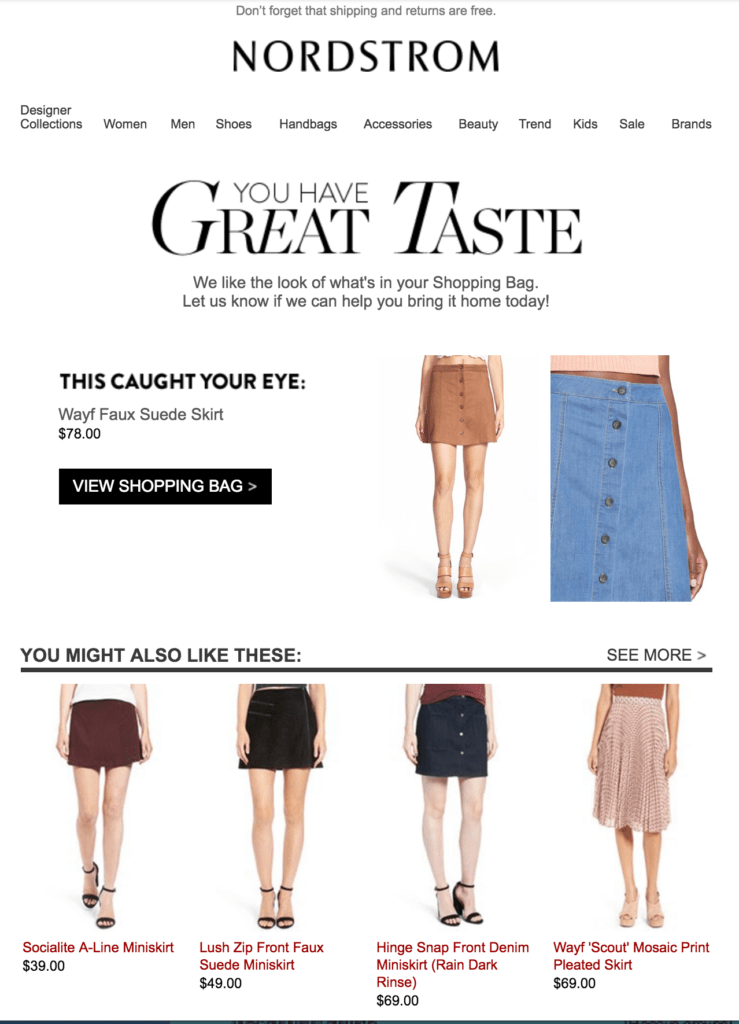
The cart abandonment email above (from Nordstrom) does a lot of things right by including:
- Great copy
- Clear CTA
- Image/info of the abandoned item
- Full site navigation
- Flatters the shopper
- Additional items of interest
- And a reminder about free shipping/returns
- Give them a reason to buy soon — Remind them that just because the item is in their cart doesn’t mean it is in stock. You can also explain that their cart will expire or that it will empty itself after a certain date.
- CTA — Include one or more calls to action in your email with formatting and design that grabs the attention of your readers right off the bat. Your cart abandonment email has a goal, make it easy to reach.
- Related items — In your cart abandonment email, give them the opportunity to view a few additional items that may interest them. Make sure the items are related by interest or category and fall into a similar price point as the abandoned item.
- Social proof — Tell your shopper what past customers have to say about the item. This kind of social proof goes a long way in developing trust with your brand and the item, both of which are necessary to get them to buy.
- Maybe a coupon code or discount? — There is research to support both sides of this argument. Will a cart abandonment email with a coupon code help to attract your shoppers back? Maybe, maybe not. The best way to know for sure is to test. Send some with, some without, and see what generates the best response.
Note: You may want to wait to include a discount until your second or third email. More on that in a minute!

The cart abandonment email above (from Jessops) does a lot of things right by including:
- Great copy
- Catchy image
- Clear CTA
- Image/info of the abandoned items
- Reminder that items may sell out
- Additional info on courses, etc.
- And a reminder about free next day shipping
Cart Abandonment Email Best Practices
Be helpful, not salesy — The most important thing to remember is that you’re sending the email to help remind them of their items. You don’t want to push them to buy. You’re sending the email as a friendly way to reach out.
Catchy images can help — The quicker you can grab your reader’s attention, the better. While high fashion brands may not want to use a picture of a cute puppy with a speech bubble as their reminder, an online pet store would do well to include it.
Include standard website navigation — Include your standard website navigation in the email that will allow shoppers to return to the exact place on your site that they choose.
Identify your tone — What type of business do you run? Can your emails be funny? Should they be classy and sophisticated? Remember who you’re mailing when constructing your perfect email.
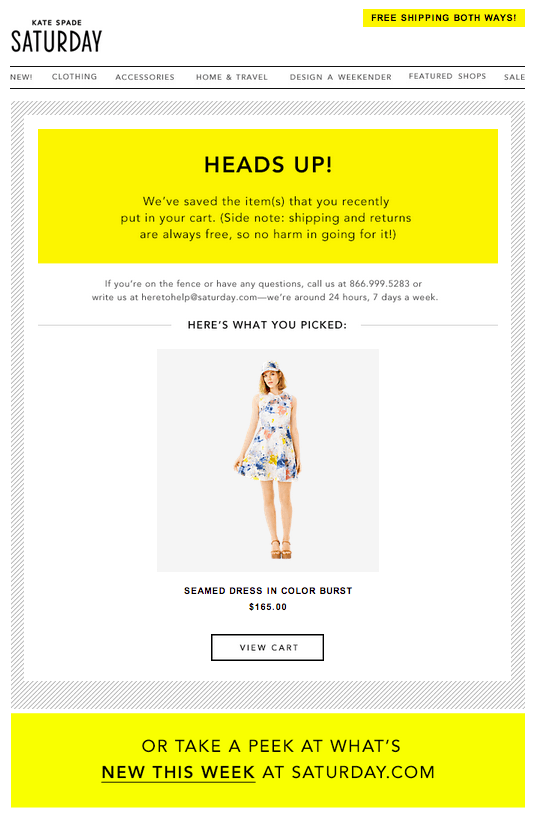
The cart abandonment email above (from Kate Spade) does a lot of things right by including:
- Great copy
- Clear CTA
- Image/info of the abandoned item
- Full site navigation
- Additional items of interest (sneak peek at what’s new)
- And a reminder about free shipping/returns/customer support
When to Send Your Cart Abandonment Email
When it comes to sending effective cart abandonment emails, timing is everything. In fact, according to salecenter.com:
- Sending an email within 20 minutes can return a 5.2% conversion rate
- Sending emails within an hour can return a 4.5% conversion rate
- Sending emails within 24 hours or more can return a 2.6% conversion rate
What does this mean? It means you should send your first cart abandonment email fast. The sooner, the better!
Subsequent Emails Increase Conversions
To increase conversions, you may want to send a second and third email too. Again, every demographic is different, so you’ll want to test for the open rates and conversions generated by the second and third emails, but it’s something you need to try out.
The second and third emails should include a sense of urgency. The subject line, headline, and copy need to make the reader feel as if they may be missing out of they don’t act fast.
Try including copy in your subject line like:
- Your items are still here, for now.
- Act fast. Get your items before they’re gone!
- Book now, while you still can!
Remember, keep the tone helpful rather than being overly pushy. These emails are also a great place to include discounts or coupon codes. If your first email didn’t reel your shopper back in, you may have to incentivize your next email to do the trick.
What Next?
You’re ready to take on whatever abandoned carts may lie in your future. Remember to keep your tone helpful, no matter what you include in your email. You’re trying to sell your shoppers softly, so don’t be pushy.
Take the list of what to include and construct your own version of the perfect cart abandonment email. Test different versions to see what your customers respond to or not, then do what works. Keep the list of best practices in mind and continually be optimizing your strategy. Time to get going!
Vanessa